By Wil Guilfoyle
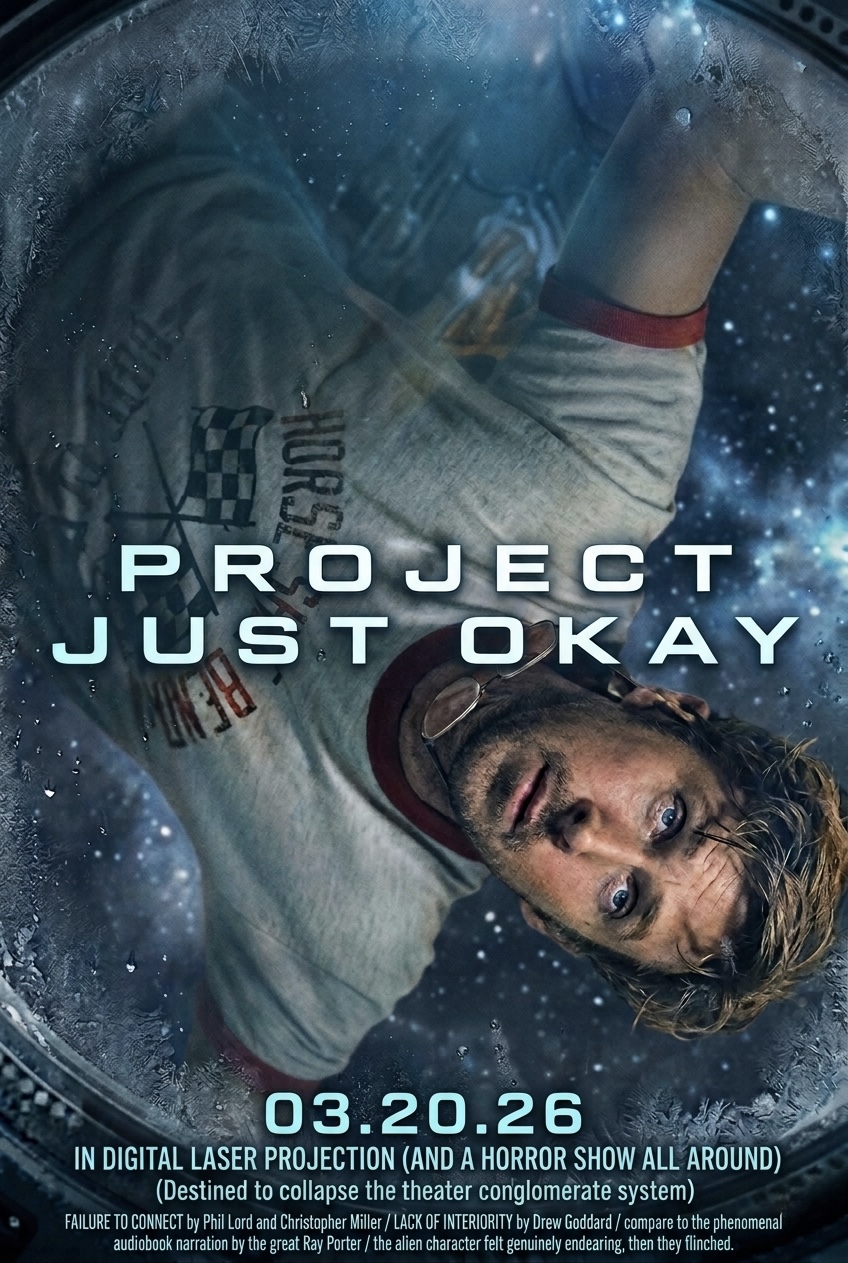
We need to talk about the state of today’s movie theater experience, and we’re going to weave this into a review of Project Hail Mary. The theater experience is not ok. The film is ok, which is damning it with faint praise. And it’s not horrible, which is damning it with faint praise again.
I hate internet culture. It enrages me every time I see a vicious review of a project that took years of collaborative effort to complete. You go on Goodreads, you find a book the whole world loves, you see the well-above-4 out of 5 star rating, and the very first user review just shits all over it. And it’s at the top because people treat reviews like influencer platforms now. The most visible review is often from someone with thousands of “followers,” which used to be a term reserved for shyster charlatans who pretended to talk to the divine for you.
These unscrupulous and deeply uncreative bastards seek out the most beloved books and films and shit all over them to graft themselves onto successful projects. They know their follower likes will push their review to the top, making it the first thing anyone sees. They’re parasites building a name out of other people’s work.
And it pisses me off.
So I’m not trying to be one of those people. But I did read the book. More precisely, I listened to the standout, phenomenal, most extraordinary audiobook, narrated by the great Ray Porter. Porter’s voice for the alien, Rocky, was electronically altered in a way that made the character feel genuinely endearing. Completely Cute and lovable. That quality was an enormous part of why the audiobook emotionally affected listeners the way it did. And Phil Lord and Christopher Miller either ignored it or didn’t understand how essential it was.
I’ve been rereading Robert McKee’s “Story: Substance, Structure, Style, and the Principles of Screenwriting,” which is a great book for any writer of any storytelling medium. McKee talks about how individual scenes are supposed to change value. If we start a scene in hope, we should end it in discouragement. If we start in love, we should end in conflict. If we start in competence, we should end in ineptitude. That constant shifting creates dramatic tension, and it’s what makes a story work.
But it goes deeper than individual scenes. Three to six scenes combine into what McKee calls a sequence, a larger structure where the accumulated shifts build to a conclusion with real story ramifications, the same way sequences of nucleotides combine to form a gene. The book, Project Hail Mary, did this fucking well. The movie? Hardly at all. The moments where all looks to be lost were handled with kid gloves. We never felt like we were in hopeless dire straits.
Whenever things seemed completely fucked, we were instantly shown the fix. That is the problem.
A story needs to make it look hopeless, and it needs to hold the audience in that hopeless place long enough for it to settle in before the saving idea arrives. The script, the directors, and the editor did not do this. They dropped the ball every time.
Ridley Scott directed The Martian, from a book by Andy Wier, the same writer as Project Hail Mary, and what he did was show the majesty of NASA, along with the majesty of the plight and environment of the long off protagonist stuck in the middle of a far off desolate place. But you were along for the ride.
Goddard’s script fails us in this respect. And I think he may even agree with this analysis. Because he’s a great screenwriter. But the film tells me that there was not a lot of interiority considered during the writing of this piece. Drew, correct me if I’m wrong.
If you didn’t read the book, you’ll probably enjoy the movie. But ok is not great, and we should all be shooting for great in a world drowning in mediocre.
Now, today’s theatergoing experience. I spent $25 on a single IMAX ticket and the first thing they did was show me 15 minutes of ads for cars and medications before we even got to the concession stand promos. Then 10 minutes of trailers, which is fine, trailers have always been part of the deal. Then the film. But why am I paying $25 to be advertised to? Advertisers pay big money for that screen time, and I’m paying big money for my seat. If you’re going to sell my attention, my ticket should be free. Pick one.
The large movie theater chains are destined to collapse. It’s a horror show all around these days. Digital laser projection, horrible sound, audiences who won’t shut up or put their phones away. Fifteen minutes of ads that I paid $25 for the privilege of watching. All of it points to the downfall of the theater conglomerate system.
The pressure from the big streaming services, combined with the abysmal experience the chains themselves provide, ensures that we’re moving into a world where smaller arthouse cinemas reign supreme again. Which isn’t such a bad thing.
These days it’s not even clear whether the United States itself will hold together, so perhaps the theater chains dying is small potatoes in the grander scheme.
For the storytellers out there, remember this: it’s about providing an emotional experience. Do not cut corners. Do not let up on the torment you give your characters, because that torment is what builds the connection between the audience and the story. That’s the whole craft. That’s everything. Unless you’d prefer the audience walk out and forget everything by the time they reach their car.
 SlowGoer | Wil Guilfoyle
Leave a comment