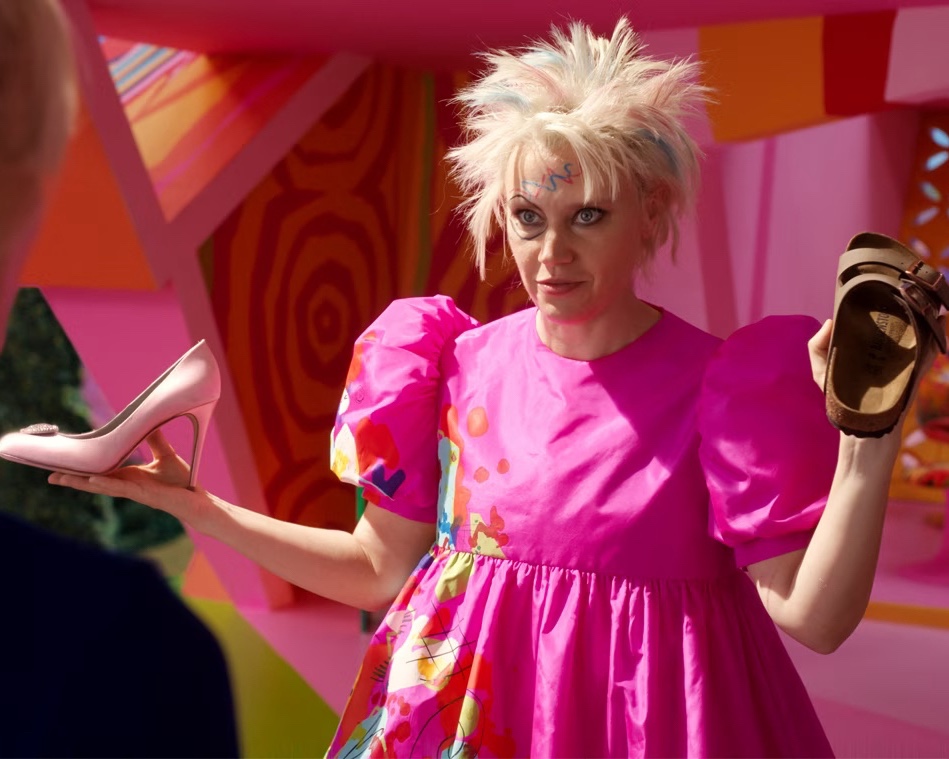
Barbie turns the plight of women in a patriarchal world into the universality of the quest for enlightenment

Birkenstocks or high-heels? Acknowledge death or live in denial? Seek out who I am or rely on my lover to complete me? These were the questions on my mind before I went to see Greta Gerwig’s new film, Barbie.
Let me start off by saying that FOX News warned me not to go see this film. But I didn’t listen. Now I’ve suddenly turned gay and think all kids should transition. Not that I didn’t like the film, but see it at your own risk.
What stuck out to me about Greta Gerwig’s new creation is the existential theme at the heart of the film.
Sure, the film is stylish, often times hilarious, has some deep heart, clearly illustrates and defines patriarchy and how it harms both women and men. But it also directly deals with death and the ever-present reality of this looming destiny we all get to enjoy.
Cultural Anthropologist and intellectual giant, Dr. Ernest Becker, won the Pulitzer Prize posthumously in 1974 for his 1973 book, The Denial of Death. This was two months after he died of cancer at the age of 49.
In the book, Dr. Becker paints a very convincing picture of the world as we know it— inhabited by cultures around the world that deny the existence of death in varying ways, particularly by never really acknowledging it. He posits that all of our wars, fights, battles, fears, suffering, anxiety, and disharmony can be boiled down to our denial of death.
On the other hand, those who have embraced the reality of the inevitability of their own demise seem to live a life much fuller, much deeper, much realer than the majority.
Socrates said, “The unexamined life is not worth living.” In my Death and Dying psychology class, my professor said, “The unexamined death is not worth dying.”
I tend to agree.
I try not to give spoilers in these film-talk reviews and discussions unless the film’s been out awhile, so I won’t give any details. But I will say that at the heart of Barbie the film is Barbie the heroine awakening to the temporary nature of existence, or, as the Buddhists say, “Change is the only constant.” She’s confronted with death and the reality of growing old and forming cellulite and feeling depressed and existential dread.
In the mythological story of the Buddha’s birth and background, he was born Prince Siddhartha. Before his birth, his father was told by the oracle that his son would either become a great King or a great spiritual leader.
Wishing his son to take the throne, he devised a plan to insulate the prince from anything that would steer him toward the spiritual path. So he hid all of the suffering from the palace and the surrounding area. He pushed out the diseased, the aging, and those experiencing any physical pain.
As the story goes, one day the Prince strayed a bit far beyond the palace walls and came into contact with an old and dying man. He witnessed this man die, and the reality of death suddenly became real to the Prince.
The Prince’s mind remained on the man who died, and on the reality of his own inevitable demise. Finally, he swore off his birth right and left the palace to go out into the world with one goal in mind: to find the cause of suffering and to be rid of it forever.
We all know how the story ends: he joined a frat, objectified women, and spent the rest of his days playing video games.
But what I’ve always found the most interesting about the story of the Buddha, from a writer’s perspective, is that the original writer of the Prince Siddhartha myth had the objective of expressing the cause of the Prince’s choice to either remain ignorant and follow the father’s wishes, or face reality and go out into the mysterious and scary world on his own.
As a writer, he or she had to sit there and say, “What would be the thing that the father can do to keep his son from even getting to decide on this choice? What will be the core dilemma that brings our hero to the crossroads?”
The answer was ‘suffering.’ Old age, disease, and death. The father character would know that these things are the very inspiration of those who ponder deeply and choose the spiritual path, so the writer had him choose to keep these things hidden from his son in order to keep the Prince in some form of blissful ignorance so that he’d remain the heir to the throne.
The reader almost never asks, “Well, how did the father know that suffering would be the spark that ignites his son’s spiritual quest?”
As the original writer of the Buddha myth knew, our innocent bewildered wonderment in the face of suffering is to be credited as our inspiration for seeking deeper meaning. Without suffering, every spiritual person I’ve personally met wouldn’t have experienced the depths of insightful understanding their inward search allowed.
Barbie is totally the Buddha in this one. She goes on the journey of her own awakening, and, dare I say it, finds her own enlightenment. Another word for ‘enlightenment’ can also be ‘insight.’
I’m being a bit unnecessarily longwinded and pompous, trying to explain to a very hip audience of readers what we all already know about the Mattel™ created toy called Barbie™…that she was always meant to represent a woman on a quest for, and then achieving, complete, unexcelled Enlightenment™.
We can all take the leap that the film’s brave Barbie has taken and face reality head on and quest for the meaning of life and death and suffering. We can ask, “Who am I?” And we can listen with our own heart for the answer.
Or we can do as Cypher did in The Matrix and enjoy a fake steak right before getting shot to death with a lightening rifle on the Nebuchadnezzar.
The choice is ours.
The End
Oh yeah I forgot….Fuck the patriarchy!
 Slow-Goer
Leave a comment